Child Psychological Abuse Evidence Organizer for Family Court
Child psychological abuse aimed at alienating a child from a parent is one of the hardest issues to prove in family court — and one of the most damaging to children. Courtroom Co-Pilot™ helps you build a clear, chronological record of alienating conduct so you can present facts instead of accusations.
 © PEK
© PEKWhy we say "Child Psychological Abuse"
Most people refer to the conduct of one parent acting to alienate a child as parental alienation, but that is not what courts and psychologists recognize. It is child psychological abuse — conduct deliberately designed to alienate a child from their parent. Using the correct term signals to judges and evaluators that you understand the serious nature of what is happening and are prepared to prove it with facts.
What is child psychological abuse?
Child psychological abuse occurs when one parent deliberately undermines the child's relationship with the other parent through manipulation, false allegations, restrictions on contact, and emotional pressure — all for the purpose of alienating that child. Common signs include a sudden rejection of a previously close parent, parroting adult language the child would not normally use, and extreme anxiety or hostility toward the targeted parent without genuine justification.
Courts and psychologists recognize this pattern as a serious form of psychological abuse. Documenting the pattern — not just single incidents — is essential because judges and custody evaluators look for consistency over time.
How to document child psychological abuse evidence
- Keep a detailed timeline. Record every denied visitation, canceled appointment, hostile message, or strange statement your child makes. Dates, times, and exact wording matter.
- Save communications. Screenshots of texts, emails, and social-media posts preserve evidence that might otherwise be deleted or denied.
- Track contradictions. Alienation claims often collapse when earlier statements are compared to later ones. A Contradiction Finder™ flags inconsistencies for your attorney.
- Gather third-party records. Police reports, CPS notes, school counselor records, and therapist observations provide objective support.
Why a Statement of Facts Report™ matters
Family court judges are busy. They do not have time to read hundreds of scattered emails or listen to emotional summaries. A Statement of Facts Report™ is a sworn, chronological narrative that presents your evidence in a clean, court-ready format — with a California Judicial Council caption page, incident categories, and supporting exhibits.
The report includes recognized categories of alienating conduct: interfering with communication, restricting visitation, making false allegations, involving the child in adult conflicts, and undermining the targeted parent's authority. Organizing your case this way turns raw emotion into admissible facts.
How Courtroom Co-Pilot™ helps
- Chronological incident log with dates, witnesses, and descriptions
- Evidence and exhibits worktable linked to each incident
- Contradiction Finder™ to spot inconsistent statements
- Agency records tracker for police, CPS, and school contacts
- Statement of Facts Report™ builder with court caption page
- Client copy with exhibits and court filing copy without them
See a sample report
Below is an excerpt from a sample Statement of Facts Report™ showing how alienation incidents are categorized and presented.
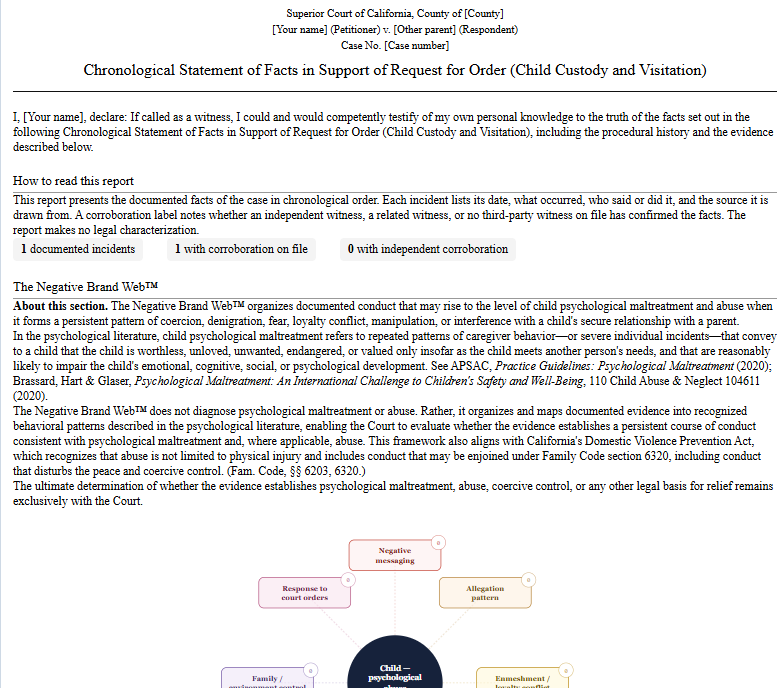
Sample only. Names, dates, and exhibits are fictional.
Start organizing your child psychological abuse evidence
Single-user access through final judgment or order. Build the record the court needs to see.